 Canada - FR
 UK
UK
 United States
 Australia
 China
China France
 Germany
 Hong Kong (SAR)
 India
India Malaysia
 Netherlands
 Latin America
 Philippines
 Singapore
-
Services
All ServicesIdentityPre-HirePost-HireSolutionsTechnology
-
Industries
- Integrations
-
Resources
-
About Us
May 2nd, 2019 | Sterling

With the unemployment rate in Canada continuing to be the lowest in decades, workers have become more and more confident in their job search, forcing organizations to re-evaluate their hiring strategy.
But before jumping to what it means for the organizations, let’s examine the current employment landscape in Canada.
Innovation – As the economy grows, Canada is struggling to keep up with the changing market. Innovation is key to a prosperous economy. Lack of innovation is a serious impediment to the growth of Canadian labor efficiency and productivity. According to CPHR[1], Canada’s performance in this area has been described as dismal based on deteriorating domestic trends as well as international perspective.
Gig economy – Whether we like it or not, the gig economy has provided an incredible opportunity for people to set their own work schedule catered to the lifestyle that they chose.From rides and food delivery to graphic designers and many other freelance services, the gig economy continues to grow. In the study conducted in the US, LinkedIn[2] predicts that by 2020, 43% of the workforce will be made up of freelancers. Many new gig-economy businesses are born out of an industry transformation, pushing the boundaries of the legislation. Contractors are the new norm blurring the relationship between individuals and the organizations through which they work.
Immigration – International Immigration to Canada reached record levels in 2018. Canada’s population grew by 168K in the 2nd quarter of 2018, of which 82% or 139K was attributed to international migration. Statistics Canada said international migratory increase was the main driver of population growth in most Canadian provinces and the Yukon Territory between April 1 and July 1. The workforce gains are even more impressive when looked at regionally. In 2016, immigrants represented half of all workers in the Toronto, Ontario, metropolitan region. Vancouver, British Columbia, had the second-highest proportion of immigrants in its labor force at 43.2 per cent, followed by Calgary, Alberta, at 32.5 per cent.
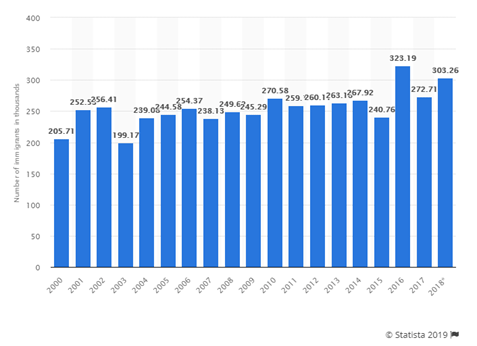
Whether your organization is expanding globally or simply hiring those with employment experience outside of Canada, the need to conduct background screening is more important than ever. And with laws and regulations that differ from country to country, this is no easy task.
As your organization re-evaluates new hiring strategies and adjusts to the new trends, it is important to remember that there is not a one-size-fits-all market. Your hiring practices should be based on the following:
[1] https://cphr.ca/blog/2017/03/29/canada-needs-aggressive-innovation-technology-development-to-compete/
[2] https://blog.linkedin.com/2017/february/21/how-the-freelance-generation-is-redefining-professional-norms-linkedin
This content is offered for informational purposes only. First Advantage is not a law firm, and this content does not, and is not intended to, constitute legal advice. Information in this may not constitute the most up-to-date legal or other information.
Readers of this content should contact their attorney or lawyer to obtain advice concerning any particular legal matter. No reader, or user of this content, should act or refrain from acting on the basis of information in this content without first seeking legal advice from counsel or lawyers in the relevant jurisdiction. Only your individual attorney or legal advisor can provide assurances that the information contained herein – and your interpretation of it – is applicable or appropriate to your particular situation. Use of, and access to, this content does not create an attorney-client relationship between the reader, or user of this presentation and First Advantage.